Guillem Michel's approach to songwriting and performing is based on extensive study and practice in a method called Corporal Circuits (CC). His training started at geiFC in Barcelona (Spain) in 2004, with Alberto Caballero in the Grupo de Investigación de los Circuitos Corporales (giCC). Ever since, he has applied the CC method in his performance and teaching.
The method of CC, elaborated by psychoanalyst and researcher Alberto Caballero, works with the body through two operators: the image and the word.
Starting with the anatomical systems – the representation and organization of the organism – this method activates and puts into circulation the 'objects' (images, sounds) in order for the subject to reach 'the words'.
This enables the subject to slowly empty the body of the jouissance 1 that affects it, to eventually achieve a re-signification which allows them to 'do' with their body.
1 The Lacanian concept referring to an enjoyment beyond Freud's pleasure principle.
About the Corporal Circuits and the giCC
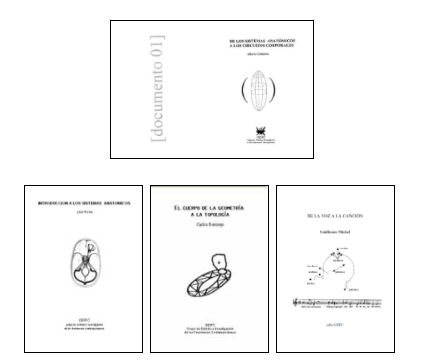
Alberto Caballero founded and coordinated geiFC (group of study and research of the contemporary phenomena) where giCC was formed and developed the method of CC. A number of publications were produced as a result of that research, starting with Documento 01 by Alberto Caballero (2006), which is essential to understanding and practicing the method of CC. Two other supplementary theory books were later created within the framework of giCC: Introducción a los sistemas anatómicos by Luís Rodas (2006) and El cuerpo, de la geometría a la topología by Carlos Bermejo (2010).
Between 2008 and 2010 a new practical text called Annexo: La veu was created. This consisted of exercises to train the voice using CC. This text was based upon Alberto's handwritten notes from his own training at the Aberastury Institute in Barcelona in the 1980's. Thanks to the practice of the exercises by the giCC, we were able to correct those notes and complete the document.
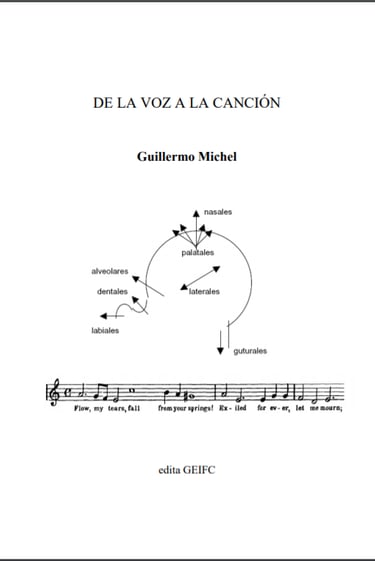
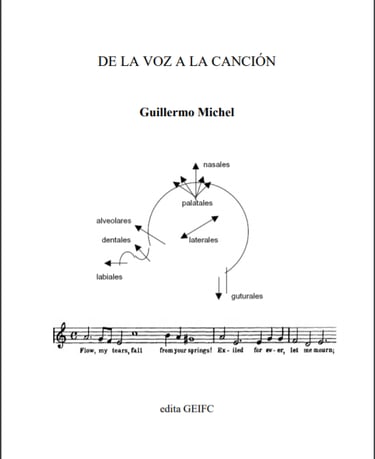
When Guillem started his individual research in 2011, he chose to focus on the 'voice' as an instrument for the song. The document named above, Annexo: La veu, was the basis for his written work, titled De la voz a la canción (From the voice to the song). This text was completed in 2014 and was published by geiFC along with the three other publications.
The Corporal Circuits, the Voice and written work
From the voice to the song
De la voz a la canción (From the voice to the song) is the product of the interaction between Guillem's musical experience and practice of CC. This text illustrates the journey of the voice, defining it as an objet petit a 2 of the subject, to reach the artistic expression: the song.
For this purpose, three questions are addressed: What is the voice in Western thinking? What is the voice as an objet petit a of the subject? What is the voice as an artistic expression?
Consisting of four theoretical and practical parts, including exercises of CC, this work aims to define these concepts, train the voice as an introduction to singing and to show the voice journey from 'the universal' to 'the singular'.
In conclusion, De la voz a la canción is intended to be an useful tool to define and train the voice, as well as a contribution for all those singers and singing students aiming to build their own unique voice.
2 In Lacanian psychoanalysis, unattainable object of desire